The first Harvard diploma in English instead of Latin appeared in 1961. When word of the abandonment of Latin came through in April, it touched off riots. Thousands of chanting students, inflamed by a toga-clad rabble-rouser on the steps of Widener Library, marched on the president's house (then in the Yard) before filling Harvard Square. Their mood was said to be jovial, the police dispensed tear gas in a fatherly way, and the rebellion came to naught. The diploma itself, the printed document, failed to stir the blood. It was said by the discerning Philip Hofer, founder and longtime curator of the department of printing and graphic arts at Houghton Library, to look "like the luncheon menu at the Harvard Faculty Club." The next year, a two-color, larger-format, more-suitable-for-framing diploma (with text still in English) replaced the menu. This design remains in use today and has been rendered by three successive printing technologies--letterpress, offset, and now a digital process using the Xerox Docutech system.
The diploma adopted in 1903 (see page 70) was also a dog, but a persistent one, lasting until 1935. Harvard historian Samuel Eliot Morison disliked its design and headed the committee that replaced it. "The cursive writing is mechanical, tightly spaced and practically illegible," writes J.F. Coakley '68. "The flabby blackletter is not much better. The dotted line for the President's signature is unsightly, and also spurious since President Eliot's actual signature had given way to a printed facsimile in about 1897." The diploma "has a mean and cramped look."
Coakley is the author of The Harvard B.A. Degree Diploma, 1813-2000, which he printed (superbly) last summer on his hand-cranked Vandercook proofing press, model 4, at his Jericho Press in Oxford, England, in Monotype Octavian and Ehrhardt on Zerkall mould-made paper in an edition of 50 copies. (The book is published by the Harvard College Library and may be had for $300 a copy by application to Monique Duhaime at Houghton.)
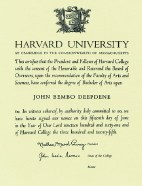 |
| The short-lived 1961 diploma. |
In the seventeenth and eighteenth centuries, if a graduate of Harvard College wanted a diploma, he paid a local engrosser to write it out, in words specified by the Corporation, and then took it to the president, with a fee, to have it signed and sealed. The first printed diploma, from an engraved plate, dates to 1813. "From that beginning until now, there have been just six different designs of the B.A. degree diploma," writes Coakley. "These are the subject of the present book--the first book, to my knowledge, on the subject of a college diploma--and they make a concise study, not only in Harvardian rhetoric but also in the history of typographical taste and the progress of printing technology." (Coakley argues in a footnote that "official Harvard style says 'A.B.' instead of 'B.A.', but for no obvious reason.
") His book is cased along with specimens of the six diplomas, some freshly printed from old plates and all but one at its original size.
Coakley earned his own Harvard diploma as a mathematics concentrator. He won a Marshall Scholarship, but deferred it to enlist in the army's 82nd Airborne Division, and actually jumped from a few airplanes. After that, he went off to Trinity College, Cambridge, switched course to read theology, did a second B.A., stayed for a Ph.D., met his wife-to-be at a party given by their professor (the radical theologian Bishop John A.T. Robinson), married, and settled. In 1993 he was living in Oxford, teaching New Testament studies at Lancaster University, when his wife, Sarah, was offered a professorship at Harvard Divinity School. Over they came, retaining their house in England, and "Chip," as he is called, became a senior lecturer on Near Eastern languages and civilizations and a cataloger in the manuscript department of Houghton.
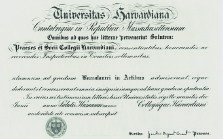 |
| The diploma of 1903. |
Coakley wrote and printed an earlier volume of Harvard history,
Veritas Imprimata: The Typography of Harvard Arms (see "Variations on a Theme," March-April 1996, page 64), reproducing 63 versions of the University's shield. To learn what else has issued from the Jericho Press, visit
www.fas.harvard.edu/~coakley/jericho.htm. Many of his publications employ Syriac and other exotic types. He likes to print something, of not too many pages, every summer. He's cranking out about 80 collects from the first English prayerbook of 1549 right now.






